


The Revolutionary War, pt. 5: A Navy is Built on Lake Champlain, and the Emergence of Mount Independence


The End of the Retreat
The invasion of Canada was over.
The defeated, demoralized, and grotesquely sick army slowly evacuated the last horrific outpost in Canada, Ile aux Noix, south to Lake Champlain. After 10 horrific days of death and misery, the living finally vacated the vile Ile aux Noix, while the hundreds of dead lay in two mass unmarked graves, never to return to America.
The next stop for the dejected and broken force was Crown Point, where the survivors (some barely surviving) slowly trickled in.
The tides had changed. For the last year, the continentals were on the offensive, invading Canada and capturing the whole of the territory, save for a small sliver of land inside the walled fortress of Quebec that General Guy Carleton had valiantly defended. The walls of the Quebec fortress that saved Canada were designed by the same engineer who designed the French Fort, Fort St. Frederic on Lake Champlain, Gaspard Chassegros de Lery.
As soon as the frozen St. Lawrence thawed out, thousands of British and German reinforcements flooded into Canada. The continentals fled in an unorganized retreat back south of the provincial line.
Now Sir Guy Carleton, recently knighted in honor of his heroic defense of Quebec and Canada, would head on the offensive when he felt the time was right.

Back at Crown Point, the new surroundings did not change the horrific state of the army. Smallpox continued to run rampant. The moans and screams of the suffering were constant. Men with puss filled sores, which sometimes bled horrifically in severe cases, called out for help. There was little to be done against this horrible disease, save for inoculation, at the time a controversial and experimental method that when done properly in conjunction with isolation, gave those who received the inoculation a slightly less severe version of the illness.
In the rush back to Crown Point, the sick were unmercifully dumped on shore. Thousands lay on the ground, with no shelter and (in some cases) unable to move, in horrific suffering. The scene was pure horror.
Many of the American leadership shared that the scene was “indescribable”. Those words mean something to the men who had, in some cases, spent decades witnessing the most horrific scenes of war. Schuyler wrote to Washington “The most descriptive pen cannot describe the condition of our army: sickness, disorder, and discord, reign triumphant”. Everything about Crown Point was horrific. The air reeked of sickness and death. The men looked like zombies. Even the ground seemed to be teeming with sickness.
In an attempt to isolate this horrific disease, the severely sick were sent across the narrow channel of Lake Champlain over to the east shore and Chimney Point, at a place called Hospital Creek. This place name actually had its origin from the French and Indian War during the British occupation of His Majesty’s Fort at Crown Point. Now, symbolically, the spot was a quarantine. Somewhere in the vicinity of Chimney Point lies a mass unmarked grave of American Patriots. The leadership convened to try to pick up the pieces and get ready for the invasion sure to come.
That American leadership in the northern theater was taking on a different element now. General John Sullivan, who had blundered severely at Trois Rivieres, rode south to resign his post as commander of the army of Canada. In his place, Congress appointed Horatio Gates, an old veteran of the French and Indian War with an endless desire to advance his career at any cost, even if it included undermining others who stood in his way.
Gates arrived at General Phillip Schuyler’s headquarters in Albany. He immediately shared with Schuyler that he was in charge of the northern forces, and Schuyler was his subordinate. Schuyler called him out on this claim, and stated he had been appointed as leader of the army of Canada. Since Canada had been evacuated, there was no longer an army of Canada, and if Gates were to serve in the northern theater, he would be under the command of Schuyler himself. The stage was set for a showdown of leadership that would shape the next year.
Both Gates and Schuyler moved north to Crown Point to witness the battered remains of the army of Canada. There they met with the recently promoted Brigadier General Benedict Arnold, after his heroics on his nearly impossible march to Quebec through the wilderness of Maine.

Arnold's Bold Plan
A council or war ensued on how to best handle this horrible situation. Arnold was the most junior of the American leadership. That did not stop him from proposing a grand plan consisting of four steps to reinvigorate the battered American force. First, they should abandon Crown Point. The defensive works were profoundly inadequate to defend even a modest British offensive. Instead, move away from the sickly Crown Point and consolidate the forces at Fort Ticonderoga.
Second, improve the defenses of Fort Ticonderoga for the impending British offensive. This would include fortifying the surrounding area of the fort, including the “old French lines” used during the Battle of Carillon in 1758. There was history at the French Lines. This was where, during the French and Indian War, Montcalm and 3,500 French defenders defeated 17,000 British and continental forces in the bloodiest battle on American soil prior to the Civil War. Arnold also suggested adding defensive works on Rattlesnake Hill, on the Vermont side of the lake opposite of Fort Ticonderoga.
The third suggestion from Arnold was sending the sick to Fort George, at the head of Lake George, to keep them isolated from the main army to greatly reduce the spread of the horrific disease.
The last suggestion was perhaps the most bold. Build a navy on Lake Champlain to hinder the movement of Carleton’s force when they arrived on the lake. This fleet would consist of row galleys, gondolas, and armed bateaux.
Arnold knew Sir Guy Carleton well. Carleton was a diligent and intelligent leader, but was prone to be overly cautious, as Arnold observed during the American retreat from Canada. If he had a navy on the lake, Carleton may delay, or even rethink, his invasion of Lake Champlain. Arnold wanted to get his attention with this proposed navy.
The counsel of war unanimously approved of Arnold’s bold plan, and the wheels were set into motion to defend the northern theater from an invasion that could likely end the Revolution.
To the north in Canada, Carleton began the work on building a naval fleet to transport the thousands of men and supplies that would be needed to carry out an invasion of the Champlain Valley and beyond. The plan was for Carleton to move south, while General William Howe would move north along the Hudson River. The two would converge on Albany, and isolate the New England colonies from the rest. The British leadership called it “cutting the head off of the snake”, as it had been the New England colonies that were largely getting blamed for beginning this treasonous rebellion.
A Storm Gathering in Canada
The British forces, reinforced by German mercenary troops, arrived in Canada with a great number of naval vessels and naval supplies. But what hindered the British advance of those naval vessels was the same obstacle that Samuel de Champlain encountered in 1609 during his ventures on the lake he named after himself: the Chambly and Saint Jean rapids on the Richelieu River. To counter this, a new fleet had to be rebuilt by the British to counter the American fleet already on Lake Champlain, which included the Enterprise, the Liberty, and the Royal Savage, a British vessel captured from Fort St. Jean during the American invasion of Canada.
Carleton, being the ever calculated and overly cautious leader, demanded naval superiority before any invasion on the lake would begin. This gave the continental forces valuable time. Time the American force in the northern theater capitalized on.

Work began on reinforcing Fort Ticonderoga. They reinforced the French Lines from 1758. Reminders were all around of that fateful and deadly day where the Marquis de Montcalm was victorious. The skeletons of dead soldiers, casualties of James Abercrombie’s horrible blunder, were all around. In a rather gruesome scene, the American forces used the skulls of the casualties of the Battle of Carillon as drinking vessels, and even used the femur bones to prop up tents.
There was also a redoubt built on a sandy peninsula just north of Fort Ticonderoga, called the Sandy Redoubt, or Jersey Redoubt, as it was manned by New Jersey colonials. The force at Ticonderoga consisted of forces from New England, New York, New Jersey, and Pennsylvania. There were also African Americans and First Nations Warriors in the camp. This caused hostility, especially amongst the regiments from the different colonies. As such, the regiments were separated to stave off conflict, with the New England regiments needing to be separated from the Pennsylvanian regiments.
As such, the commanders of the fort thought it prudent to assign different colonial regiments to different areas of the fortification. The Pennsylvania men fortified the old French lines, as well as an advanced guard at Crown Point. The New Jersey forces manned the Sandy redoubt, also called the Jersey Redoubt. The location of this redoubt is usually under water today. This is owing to the rise of the level of Lake Champlain caused by the damming of the Richelieu River to the north, in addition to the expansion of the Chambly canal, that was done in the 1960’s. This caused the level of Lake Champlain to rise about 3 feet. In addition, there was a blockhouse built on Mount Hope, a high mount to the west of Fort Ticonderoga. However, they did not fortify Sugar Loaf Hill, soon to be known as Mount Defiance. This would come back to bite them.
The Emergence of Mount Independence
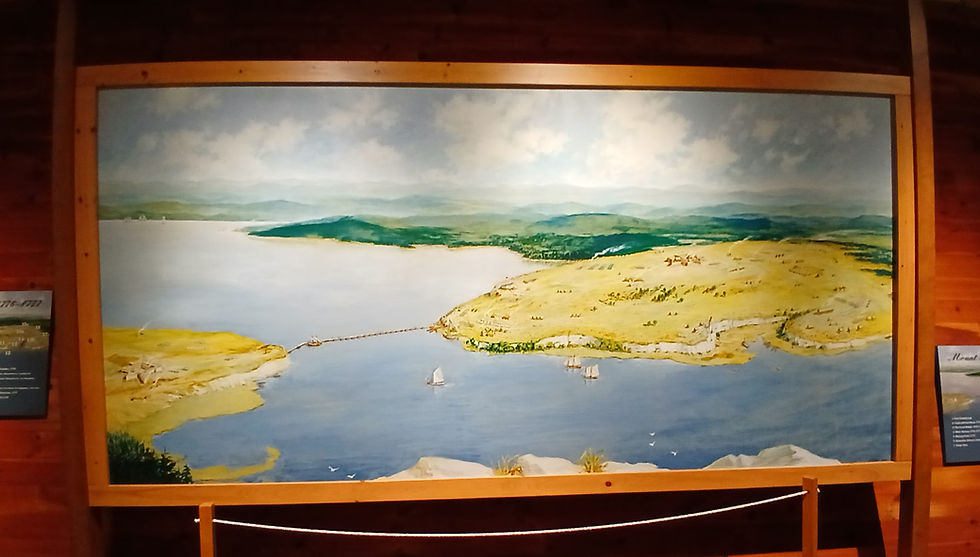
But the position and orientation of Fort Ticonderoga left something to be desired for the American forces. Fort Ticonderoga was initially built by the French in 1755 as Fort Carillon during the beginning of the French and Indian War.. As such, the French oriented the fort to protect against an invasion from the south by the British. In 1776, the Americans had to concern themselves with an invasion from the north. Fort Ticonderoga did not have a proper line of sight to the north, which put them at a disadvantage. Jeduthan Baldwin, an American engineer, had learned the art of defensive works and structures during his time under Captain William Eyre during the French and Indian War. He took a major part in the building of Fort William Henry at the head of Lake George, the fort that met a fateful and impactful end during the siege and “massacre” of Fort William Henry.
Across Lake Champlain, work began on the fortifications on Rattlesnake Hill. Baldwin took the reins of these new defensive works, on a hill that elevates 200 feet over the lake. Over the next few months, they began construction on a star-shaped fort, several blockhouses, a hospital, and several batteries. Among the batteries was the grand battery on the northern extremity of the hill, and the horseshoe battery on a high bluff above the grand battery. The site also included several dwellings and quarters for the officers. The star fort was an eight-sided picketed fort that covered an area of almost four acres.
Then finally, in the second half of July, the morale boost that the defeated army of Canada needed finally came. News arrived at Ticonderoga of the Declaration of Independence. America was now a free and independent country, separate from the tyranny of a strong-handed king.

On July 28th, 1776, a copy of the Declaration of Independence arrived at the fort. Arthur St. Clair gathered the force, and read aloud, word for word, the declaration in its oratory eloquence. The words were read aloud. “We hold these truths to be self-evident, that all men are created equal, that they are endowed by their Creator with certain unalienable Rights, that among these are Life, Liberty and the pursuit of Happiness.” At the end of the document, a list of grievances against the King were listed.
“has made Judges dependent on his Will alone, for the tenure of their offices, and the amount and payment of their salaries.”
“He has erected a multitude of New Offices, and sent hither swarms of Officers to harrass [sic] our people, and eat out their substance.”
“He has kept among us, in times of peace, Standing Armies without the Consent of our legislatures.”
“He has affected to render the Military independent of and superior to the Civil power.”
“For cutting off our Trade with all parts of the world:”
“For imposing Taxes [and tariffs] on us without our Consent:”
“For depriving us in many cases, of the benefits of Trial by Jury:”
“For transporting us beyond Seas to be tried for pretended offences:”
“A Prince, whose character is thus marked by every act which may define a Tyrant, is unfit to be the ruler of a free people [emphasis added by author].”
With St. Clair’s well educated and informed oration of the declaration, he followed the reading up with “God save the free independent States of America!” This was followed up by three cheers from the men in the ranks. We were no longer 13 colonies, we were 13 united states.

In celebration of this momentous occasion, the new works being built to the east of Fort Ticonderoga on Rattlesnake Hill were renamed Mount Independence. The name the mount carries to this day. Mount Independence is now a Vermont State Historical Site opened during the summer months. In contrast to the grand and awe-inspiring rebuilt Fort Ticonderoga across the lake, Mount Independence lay almost virtually untouched and authentic. It is widely considered the least-disturbed Revolutionary War site in existence. With over four miles of walking trials, one can truly let their historical imagination run wild, while surrounded by beautiful and pristine nature.
A Navy is Built in Whitehall
At the southern end of Lake Champlain, work was under way to greatly enhance the American fleet on Lake Champlain. At the site of Philip Skene’s former settlement at Skenesborough, the American forces had built a naval yard to construct these new vessels. Skene’s former settlement was the perfect spot. Skene had built a dam, sawmill, several barns and warehouses, and a foundry. The finished vessels could be launched directly into Lake Champlain.

As such, Whitehall, NY, as Skenesborough was renamed after the Revolutionary War, is sometimes called the “Birthplace of the United States Navy”. However, that claim does not come without controversy. Even though there was a significant naval fleet built at Whitehall, those who discount the claim state that this was an army action, and not the navy, which had been established in 1775. However, the difference between the Army and Navy at this time was a very thin line, sometimes without clear distinction.
Even then, going back to the previous year of 1775 during the Capture of Fort Ticonderoga, the continentals captured Philip Skene’s sailing vessel, the Catherine. She was armed and renamed the Liberty. Regardless of whether you consider it an army or a navy action, the Liberty was America’s first warship. Semantics aside, there is a very strong case to be made that Whitehall is indeed the “Birthplace of the United States Navy”.

But the work on the vessels at Skenesborough was lagging dangerously behind schedule. The self-declared “commodore” Cornelius Wynkoop, was a headstrong man with a lack of any sense of urgency. George Washington wrote to Horatio Gates that the building of the American fleet to counter Carleton’s fleet was of the utmost importance to the American cause. Washington then suggested that Benedict Arnold be placed in charge of the construction of the naval fleet. Gates enthusiastically agreed, and Arnold was placed in charge, even if Wynkoop still thought he was in charge.
Arnold’s first action was to take three completed vessels north on the lake to procure lumber for the shipbuilding effort. An expert mariner, Arnold knew exactly what kind of wood would be best for the construction of the fleet. He likely went to Willsborough, and may have even gone as far north as Simon Metcalf’s sawmill at Swanton. At Arnold’s urging, all other lumber was burnt to prevent use by the British forces once they entered Lake Champlain.
As he was north on the lake, Benedict Arnold took the time to take sounding measurements, measuring the depth of the water at certain bays and channels. He went as far north as the Onion, or Winooski River and past an island called Valcour Island.
Arnold, the former mariner himself, had the perfect blend of knowledge and personality to propel the building of the fleet to the next level, with a great sense of urgency. He immediately ordered the building of new row galleys, about 70 feet in length. These row galleys would be better at maneuvering Lake Champlain, where many shallow shoals and changing winds meant that vessels had to be built to withstand these varying elements. Once the hull was finished in Skenesborough for these galleys, they were rowed up to Mount Independence, where a crane hoisted the mast onto the vessels. Mount Independence was also where the vessels were armed with cannon and swivel guns.

Gates was very impressed by Arnold’s efforts, writing to Congress that Arnold gave “life and spirit to our dockyard”. While Arnold brought the energy and enthusiasm, they were still lacking in the specialized maritime parts needed to construct such vessels. Being in a remote wilderness, this took a stroke of logistical genius. That was due in large part to Philip Schuyler. While Schuyler does not get the battlefield praise in the many histories of the Revolutionary War, he provided something almost equally important to the army. He was a logistics master. His many connections in Albany and down the Hudson River Valley were invaluable. Much of the supplies were purchased from Albany mariners whose vessels were trapped due to the British presence in the southern Hudson Valley.
Arnold Snaps
But before Arnold could set off with his navy, there was another matter which Benedict Arnold had to deal with. Moses Hazen was a veteran of the French and Indian War and fought with Rogers Rangers during that conflict. He had moved to Canada after the war and was a merchant near St. Jean. For the first few weeks of the Revolutionary War, Hazen played off of both sides, weighing his options for the best business outcome. Neither side trusted him, and at certain points both the Americans and the British had him arrested.
Eventually he chose the American side, and even became the commander of the 2nd Canadian Regiment during the invasion of Canada. As was so often the case, Arnold rubbed Hazen the wrong way, and the two had a disagreement. That disagreement turned into downright hostility. Benjamin Franklin and the other congressional delegates sent to Canada had authorized Benedict Arnold to confiscate supplies in Montreal in exchange for the promise of a future payment.
Moses Hazen felt that this was unjust to his fellow merchant-friends in Montreal and voiced his outrage when Arnold tasked him with taking the confiscated supplies back to Lake Champlain. Hazen sent the supplies to St. Jean, but by the time Arnold had arrived there, the supplies were gone. Arnold directly blamed Hazen, and Hazen denied all wrongdoing. As such, there was a court martial to take place at Ticonderoga, and Arnold was there to make his case for justice against Hazen.
During this court martial, Hazen struck up a relationship with John Brown, who along with James Easton, started the famous smear campaign against Benedict Arnold shortly after the capture of Fort Ticonderoga the previous year. The court martial proceeded, and by all accounts seems to have been a fair proceeding.
But Benedict Arnold’s fatal flaw of character was about to reveal itself yet again. Arnold could not handle any actual, or perceived, slight against his character. When the proceedings directly questioned Arnold’s rationale and decision-making, he flew off the handle. He went on a profanity ridden tirade, and even made threats. He then challenged those who took part in the proceedings essentially to settle it with a duel. This was dangerous territory for Arnold. He notoriously had no patience for those he deemed fools, and his bluntness won him no fans during these proceedings.
Hazen was found not guilty, and when the members of the court martial had a celebratory dinner, they issued orders to arrest Benedict Arnold for contempt of court in retribution for his outburst. It was at this point that Horatio Gates personally stepped in and acquitted Arnold of any charges. Gates could not lose his naval commander at such a critical time. Arnold was happy to be acquitted, but he would not forget this slight against his character.

The Navy is Launched
Back at Ticonderoga, Gates remained on high alert, fearing any day that the British fleet would come sailing down Lake Champlain. It was imperative that Arnold get what vessels were completed manned and deployed into the northern part of the lake. The three schooners, a sloop, and a few gondolas made their way north. The row galleys were still under construction. As they were ready to move north, Cornelius Wynkoop, the self-proclaimed “commodore”, fired a shot at Benedict Arnold in a very stupid and reckless manner over a minor disagreement. Arnold was convinced the old man had lost it. He wrote to Gates, who had Wynkoop immediately removed from Lake Champlain.
Just as Arnold was ready to set sail, Arnold welcomed the new surgeon to the fleet. His name was Dr. Stephen McCrea. Dr. McCrea was the brother to Jane McCrea, a loyalist who was engaged to a soldier in the British camp. Jane would meet tragedy the following year in 1777 in one of the most well-known murders of the Revolutionary War. We will cover this in more detail during the Saratoga campaign. Her tragedy is woven into the fabric of America’s founding.
It was finally time. Arnold set sail to the north with 10 vessels, including the gondolas, the Boston, Providence, New Haven, Philadelphia, Connecticut, and Spitfire. There were two schooners, the Revenge and the aforementioned Liberty. There was the sloop Enterprise, and Arnold’s flagship, the schooner Royal Savage.
With the British fleet nearing completion to the north, the stage was set for a naval battle on Lake Champlain that would take on critical importance. The defense of the cause of liberty fell squarely on the shoulders of Benedict Arnold and his naval fleet. The clash would take place at Valcour Island.
Sources:
Anderson, Mark R. "The Battle for the Fourteenth Colony: America's War of Liberation in Canada 1774 - 1776"
Atkinson, Rick. "The British are Coming: The War for America, Lexington to Princeton, 1775-1777"
Barney, Jason. "Northern Vermont in the Revolutionary War"
Bellico, Russell P. "Sails and Steam in the Mountains: A Maritime and Military History of Lake George and Lake Champlain"
Cohen, Eliot A. "Conquered Into Liberty: Two Centuries of Battles Along the Great Warpath That Made the American Way of War"
Coolidge, Guy Omeron. "The French Occupation of the Champlain Valley 1609-1759" Second Edition.
Gadue, Michael. "The Liberty: First American Warship, Among Many Firsts" https://allthingsliberty.com/2019/06/the-liberty-first-american-warship-among-many-firsts/#:~:text=The%20Liberty:%20First%20American%20Warship,Journal%20of%20the%20American%20Revolution
Kelly, Jack. "God Save Benedict Arnold: The True Story of America's Most Hated Man"
Kelly, Jack. "Valcour: The 1776 Campaign that Saved the Cause of Liberty"
Laramie, Michael G. "By Wind and Iron: Naval Campaigns in the Champlain Valley, 1665-1815"
Millard, James P. "Lake Passages: A Journey Through the Centuries. Volume I 1609-1909"
Morton, Doris B. "Birthplace of the U.S. Navy"
Nelson, James L. "Benedict Arnold's Navy: The Ragtag Fleet that Lost the Battle of Lake Champlain but Won the American Revolution"
Philbrick, Nathaniel. "Valiant Ambition: George Washington, Benedict Arnold, and the Fate of the American Revolution"
Staff at the Chimney Point State Historical Site, communicated on July 3rd, 2020
Stout, Neil R. "The Birth of the United States Navy" featured in "Lake Champlain: Reflections on our Past" edited by Jennie G. Versteeg
Wickman, Donald H. and the Mount Independence Coalition. "Strong Ground: Mount Independence and the American Revolution"


