


The Revolutionary War, pt. 4: Arnold's March to Quebec, Franklin's Visit to the Valley, and the "Living Hell" at Ile aux Noix

The Continentals in Canada
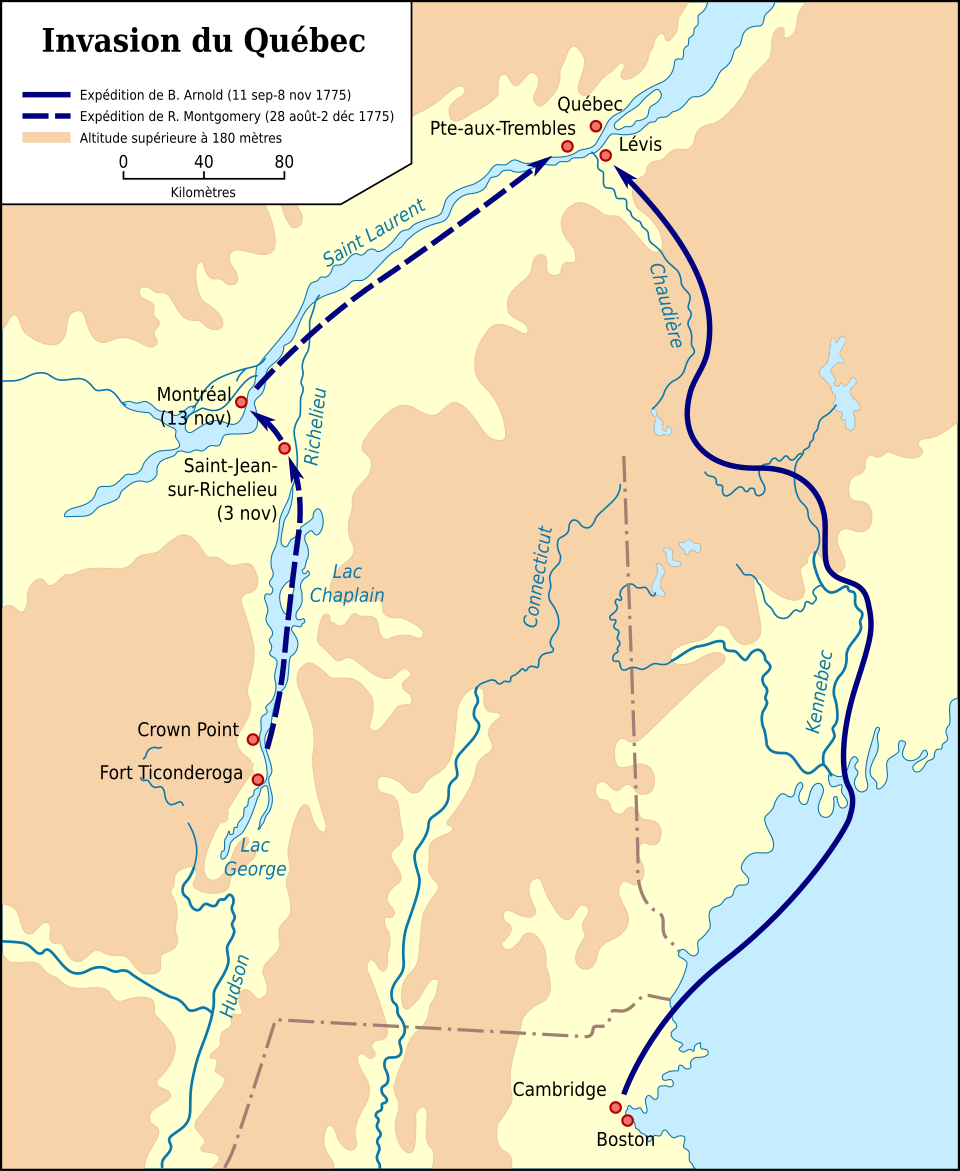
In November of 1775, Montreal was an American city. General Richard Montgomery and his force moved northwest from St. Jean to Montreal, capturing the famed Canadian stronghold. Montgomery secured badly needed supplies, and waited on news of a second prong of the invasion of Canada to the east, where they would converge on Quebec in hopes of expelling the British from Canada.
A few months before in New Haven, Arnold had returned to his home to grieve the passing of his wife and sort his personal business. But Arnold felt a calling to get back into the fight. He asked his beloved sister Hannah to take care of his three children, and left for the outskirts of Boston.
When he arrived, Benedict Arnold met George Washington for the first time. Washington, like many others, admired and respected Benedict Arnold and his passion, detailed planning, and vision. Arnold supported the invasion of Canada, and proposed to General Washington a second prong of attack into the north. Arnold proposed that this second prong of invasion go north to present-day Maine. They would proceed up the Kennebec River to the Dead River, go over the mountain pass, and eventually to Lac Megantic and the Chaudiere River, which would lead them directly to Quebec. There he would meet up with General Montgomery. Washington fully supported the plan, even though there was only one crude 15 year old map of the area that would guide the men and women. Arnold had no idea what the force was in for. They believed the route would cover 180 miles and take 20 days. Instead, the journey ended up being 270 miles and took 45 grueling days.
Arnold's Grueling March to Quebec

Arnold led his force of 1,000 men from Newburyport, Massachusetts, to the mouth of the Kennebec River. The force included many who would become famous, including Daniel Morgan, the future hero at Saratoga, as well as Henry Dearborn, another hero at Saratoga who additionally spent time in the Champlain Valley during the War of 1812 leading a force on another invasion of Canada during that conflict. Also among the troops was the infamous Aaron Burr, who famously killed Alexander Hamilton in a duel.

On bateaux, his force moved north to Fort Western in Augusta, Maine. Once they loaded up on provisions, they moved north. Things quickly turned difficult as the rocky Kennebec River made quick work in destroying many of the hastily-built bateaux. Provisions were almost immediately lost in the raging river. After only 10 days, the men were already forced to ration their food supplies.
The treacherous journey caused Arnold to comment that his men had become amphibious due to the amount of time spent trudging through the water. By October 11, exactly one year before Arnold would lead the American forces in a naval battle on Lake Champlain, Arnold’s men had reached the great carrying place that would lead to the Dead River. It was named so because at the time, the river was known for its placid water. Now, dams have caused a much greater flow on the Dead River. It was a very difficult portage.
The journey had been treacherous up to this point, and was only about to get worse. After another portage to a pond, the men’s spirits rose when they saw a wide open field, vastly different from the rugged, rocky, and thickly forested wilderness they had seen up to this point. But the optimism soon waned once they realized it was a peat bog. They were soon knee-deep dredging through mud. The weather was also turning colder. The men’s uniforms were stiff with ice when they awoke in the morning. Sickness was also starting to take its toll. Further along the Dead River, three days of rain all of the sudden turned into a hurricane. Torrential downpours accompanied with horrific wind hampered the movement of the group. The land around the Dead River was very flat, and in the middle of the night, the river jumped its banks and came rushing through the encampment. They rushed to a nearby hill and spent a miserable night there.
The next morning, they realized the river had risen 8 feet, and they could no longer discern where the main flow of water went. Yet they pressed forward, at the encouragement of their leader, Benedict Arnold. Then, the force lost control of the supply vessels, and many of their provisions, arms, and gold and silver specie rushed away in the current. They set up for the night at a place they called “Camp Disaster”.
Even Arnold was beginning to have his doubts. Arnold called a council of war that included Daniel Morgan and other leaders. He let each man have a say. They were well beyond the settlements of Maine, and the inhabited areas of Canada lay much further ahead. Arnold was unsure what to do. They had already endured so much hardship. Could he ask his men to take on more? His men, many of whom were too sick to carry on, were dependent on the decision he was to make. They eventually settled on moving forward, with those deemed too sick to continue on to be sent back to Boston.
Arnold sent a note to the leader of the rear column, Roger Enos, sharing his decision. Enos on his own accord then decided to hold his own council of war with his men. They decided they would not go on with the mission. Not only would they turn back, they would take most of the provisions and cooking materials with them. It was a cowardly and treasonous action that left the remaining army seemingly for dead. The remaining force was so angry that they prayed that Enos and his men would die on the way. Enos returned to Boston where he faced a court martial, but was found not guilty, mainly because none of the force he betrayed was present at the hearings.
The force, now desperate for food and clothing, moved forward to the height of land between the Dead River and Lac Megantic. It was steep and treacherous, and very difficult to descend, especially with the few provisions remaining. Once they reached Lac Megantic, they reached the inlet of the Chaudiere River, which would lead them right to Quebec. But the river was no lazy river. The name Chaudiere translates to boiling cauldron owing to the steep waterfalls and numerous rapids along the way. Henry Dearborn found his force off the path. In an icy swamp, his men had to use their muskets to break up the ice to make it to the other side. They eventually made it to the shores of Lac Megantic, but several men perished from exposure.
Accompanying the force was a woman by the name of Jemima Warner. Step by step, she moved along with the army through this unforgiving terrain. She looked back and found her husband had fallen ill and was near death. She moved back just before her husband perished. She covered his body with leaves instead of burying him because the ground was frozen solid. She then grabbed his musket and powder horn, and continued on with the army.
At this time, Arnold had moved ahead of the force in a desperate attempt to secure food for his men. He ran into two Penobscot natives, who told him where the closest French civilization was. He was closing in. The question became, would the Habitants be hostile, or would they help Arnold’s starving force.

Back at the main camp, desperation was setting in. The men boiled shoes and ate it, they ate candles, cartridge boxes, soap, seemingly anything that could stave off the horrible aches of hunger. Then, in a horrific act of desperation, Henry Dearborn’s beloved Newfoundland Lab became a casualty in the fight against starvation.
Arnold finally reached civilization north on the Chaudiere. He had reached the village of Sartigan, near present-day Saint-Georges Quebec. The moment of truth had arrived. When he approached the Habitants, they greeted him with a warmth and compassion he was not expecting. These Canadians knew hunger. For many years towards the end of the French and Indian War, the harvests had failed, leading to widespread food shortages. With empathy in their hearts, Arnold was able to purchase some cattle for food out of his own pocket. Some even refused payment and helped bring the cows and other supplies back to the main army. He would never be reimbursed for his expenses. He marched back to his starving men as fast as he could. When Arnold approached the main force, it must have appeared as an illusion at first. Dearborn, who just lost his dog, shed tears when he saw the provisions and cattle. The army rejoiced having its first proper meal in weeks.
As the army moved north, they were surprised by the kindness and hospitality shown to them by the Habitants of Canada. Many of these men grew up knowing the French Catholics as the enemy, a vile group bent on terror and destruction. Instead, what they found was kindness at a time they needed it the most. They welcomed the Americans into their homes. They fed them, and even lent them some clothes. Even though they were unfamiliar with the Catholic customs of the Habitants, they showed respect for them. Some of the men were particularly taken aback by the French Canadian women and their clothing, or should we say lack thereof.
If it weren’t for these Canadians and their hospitality, Benedict Arnold’s army would have starved long before they reached Quebec. The journey was the stuff of legend. Through a howling wilderness, Arnold’s force braved unforgiving conditions that included starvation, a hurricane, snowstorms, freezing temperatures, and a mutiny that cost them almost all of their food. Benedict Arnold was the man that led them through. He showed leadership when it was needed the most, and saved most of the army from absolute disaster. The feat would earn Arnold the nickname of the “Hannibal of North America”. The force made it to Point-Levis on November 9th, on the south shore of the St. Lawrence River opposite of Quebec. He had roughly half of the force that he set out with.
Montgomery's and Arnold's Forces Meet

Meanwhile, back in Montreal, Montgomery had entered the city on November 13th. Governor Guy Carleton had barely escaped. He had to dress as a habitant, and fled on a small boat towards Quebec. Montgomery was glad to be in Montreal, at this point an American city. He found clothing for his men. Although the clothing was British redcoats, which would cause massive confusion later on.
But there were other issues General Montgomery had to deal with. He pleaded with Congress to send a delegation to help with civil matters. He had plenty to keep him busy with military logistics, but he desperately needed help working with business leaders and the church. He had started a dialogue with Jesuit leaders, who had been banned from by the pope. He promised to restore some power to them if they would assist with the Habitants. At this point, Bishop Briand had banned anyone sympathizing with the Americans from receiving holy communion or giving confession.
At one point, Congress did send a delegation. That delegation never actually went to Canada. They went only so far as Fort Ticonderoga, and after conferring with General Schuyler, decided not to proceed to Montreal.
General Montgomery wanted Canada to form a self-governing society. But without civil leaders in Canada, Montgomery simply would not have the time to make this happen.
On the business side, he had to deal with the issue of supplies and trade. He needed hard silver and gold coin. Dating back to the end of the French and Indian War, the inhabitants of Canada were weary of paper money. The paper money France issued out was useless. As such, there was an inherent distrust for paper money. Gold and silver was desired, but was in short supply.
Montgomery also enforced strict discipline among his men. There was to be no harassing or looting of the local populace. This was enforced by the penalty of death. For the most part, the men listened, and in the same manner as Arnold’s force, found the Habitants to be quite friendly and hospitable, even if they found the Catholic traditions strange. George Washington even went so far as to ban Guy Fawkes Day celebrations, popular amongst protestants, where they traditionally feasted and burned an effigy of the pope.

Arnold had made it to the Plains of Abraham. Although the surrounding valley near Quebec did not garner the same armed support for the American cause that the Richelieu River Valley did, Arnold did find some support. Amongst those who supported the American cause were Clement Gosselin and Pierre Ayotte. They were very active along I’le Orleans and the south shore opposite Quebec City. Both men would eventually settle in the Champlain Valley after the war in a tract of land called the Canadian and Nova Scotian Refugee Tract. Ayotte settled in Chazy, while Gosselin eventually settled in Beekmantown.
Arnold crossed the river and landed on the Plains of Abraham, the site of the epic battle between James Wolfe and the Marquis de Montcalm that saw both men lose their lives. He was frustrated to learn that Allan MacClean had just arrived at Quebec with his regiment of highlanders. Had he arrived several days earlier, Quebec would have been virtually undefended. Guy Carleton had also made it into the walled city of Quebec. They had plenty of food to outlast the Americans, but were severely short on firewood.
Arnold sent three different messages under a flag of truce, only to have the man with the message shot at in a blatant violation of warfare norms of the time. Attacking the city on his own would have been ill-advised. He would wait for General Montgomery. Finally, on December 3rd, the two forces met at Point aux Trembles. Montgomery and Arnold struck an immediate mutual respect, and planned the next moves.
They tried their best to shore up defenses. The ground was frozen, so earthworks were out of the question. Instead, they used blocks of ice and made an ice battery. While innovative, it did not hold up well to cannon fire and was destroyed a couple of days later. It was decided they would have their best advantage during a snowstorm, so they patiently waited. Meanwhile, Daniel Morgan and the Virginia Rifleman were very effective, picking off targets one at a time and keeping the inhabitants of Quebec very uneasy.
As luck would have it, that stretch in December was rather dry. They came close to making their move on Christmas Eve, and Montgomery stated that, come tomorrow, he would either be dining in Quebec or dining in hell. But the weather once again would not cooperate, and they waited. The clock was ticking. Enlistments expired on December 31st. If they didn’t make a move, it would all be for not.
The Battle of Quebec

Just as 1775 was giving way to 1776, a momentous year in the conflict, Arnold and Montgomery were about to take place in the climax of the Invasion of Canada. Their target was the walled city of Quebec, perched atop an intimidating bluff. The fortified city was the most intimidating in North America. It was damn near impenetrable. Yes, the British under Wolfe had defeated the French under the Marquis de Montcalm in 1759. Not to take away from the incredible feats of the British army in Quebec, but that victory was in large part due to Montcalm losing his patience and taking the bait to fight on the Plains of Abraham, outside of the fortified city. Had Montcalm stayed within the walls of Quebec, things may have been very different.
Benedict Arnold and Richard Montgomery had been patiently waiting for a snowstorm to make their attack. The timing lined up for New Year’s Eve, the day before many of the Continental Army’s enlistments were set to expire. It was now or never.
Inside the city’s walls, Governor Guy Carleton only had 300 regulars to defend the city. He had food rations to last until spring, when a British flotilla was expected to arrive once the St. Lawrence River was free from ice to relieve the city. That said, he was dangerously low on firewood. In desperation, they used any furniture they could find to set fire to keep the inhabitants warm.
To make up for the lack of fighting men, Carleton ordered all male inhabitants of the city to either take up arms, leave the city, or if they chose to stay, face imprisonment as a spy.
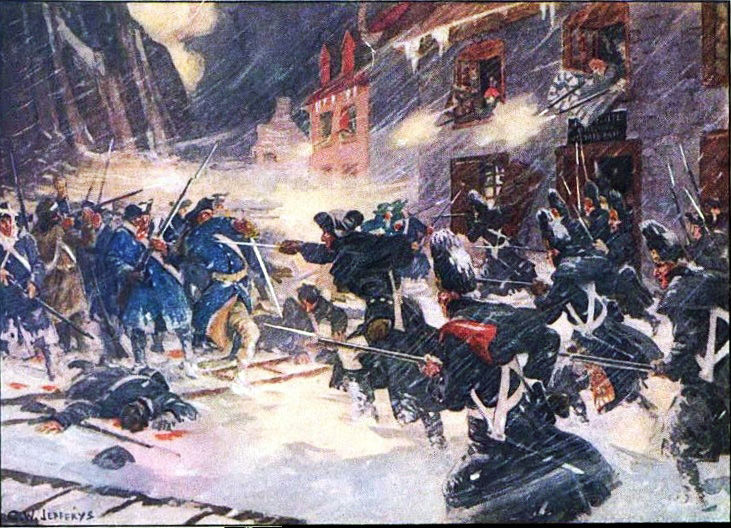
As nighttime set in, Arnold and Montgomery made their moves. Their first target was the lower town. James Livingston and the French-Canadiens allied with the Americans launched a diversionary attack from the west. At 4am, Livingston’s men launched two rockets over the city, the signal that the siege was beginning. Livingston and the Canadiens had lit a fire and attempted to garner as much attention as possible. But guards had noticed the movement near Montgomery’s camp. Carleton and his men called Livingston’s bluff, and focused his attention on Montgomery’s Main force, moving south of the upper town from the west. Simultaneously, Arnold moved toward the lower town from the north.
The storm was horrific. The intense snow in combination with a howling wind made for whiteout conditions. The men kept their muskets under their coats in an attempt to keep their arms in good firing condition. Pinned to many of the continental’s hats was a piece of paper with the phrase “liberty or death”.
Moving single file along a narrow path which had cliffs on one side, and large chunks of ice from the river on the other. Montgomery lifted his sword at the front of the force, and signaled the move forward. Grape shot from a nearby British blockhouse fired in his direction. Montgomery was killed instantly, along with almost a dozen others. The command now fell to Donald Campbell, a veteran of the French and Indian War who took part in the famed Battle of Carillon in 1758. Sensing the suicidal similarities of a continued attack, Campbell ordered an immediate retreat.

Meanwhile, Arnold had led his force from the north. They found formidable defenses along the path they took, along with continual fire from the city above. A bullet had ricocheted off of the cliff walls and had entered Benedict Arnold’s left leg, the same leg that would once again be wounded at the climax of the Battle of Saratoga almost two years later in 1777. Arnold could not move, but urged his men forward to fight with everything they had. He wished to go on, but severe blood loss caused him to go to the hospital.
Somehow the storm had intensified since the beginning of the attack. Arnold’s force was essentially marched into a trap, especially since the retreat of Campbell had freed up some of Carleton’s men to focus on this force. Of the 500 men in Arnold’s wing, 372 were captured, with over 60 casualties. Daniel Morgan, in his hatred of the British who had lashed him 500 times in the French and Indian War for insulting an officer, refused to surrender his sword to them. Instead, he gave his sword to a nearby priest.
The battle was over. Montgomery was dead, Arnold wounded, and almost 400 captured. It was a disaster. Almost everything that could have gone wrong, did go wrong. Unfortunately, Livingston’s French Canadiens made a convenient scapegoat, and were largely blamed for the failed attack.
Arnold remained bedridden for over a month, but still carried about his duties as the new commander at Quebec with a great fury. Arnold pleaded for more reinforcements, supplies, and hard currency in hopes that he could still take Quebec and drive the British out of Canada. But the tides were changing.
The Canadian Occupation Falls Apart

Reinforcements did come, and they came by the hundreds via Lake Champlain. Many came from Pennsylvania and New Jersey along the frozen lake in horrific winter conditions. Lake Champlain saw a great deal of foot traffic from these reinforcements. They went to Fort St. Jean, Montreal, Trois Rivieres, and Quebec.
But the discipline of the army up to this point of the invasion did not transfer to these reinforcements. They harassed the local populace, plundered homes, insulted the Catholic Habitants, and drove many from neutrality in the conflict to the side of the British. Some undisciplined forces even shot at the Canadiens as they were on their way to Sunday mass. In another incident, an American killed a Canadian with a bayonet to the throat over a small debt near Trois Rivieres. Even in areas with a large pro-American contingent like the upper Richelieu River Valley, they harassed the locals.
The Americans had also run out of money to pay for supplies. The locals, who inherently did not trust paper money owing to the rapid depreciation of French paper money at the end of the French and Indian War, would only take silver and gold specie. Meanwhile, Canada still lacked what Montgomery had wanted all along, a bureaucratic policy and diplomats to help with civilian causes in Canada.
The Americans were broke, hungry, lacked discipline, and lacked proper civilian oversight in Montreal. But it only got worse. Smallpox, which had hindered the American forces in Canada from the beginning, was now ravaging out of control. At certain points, over half of the Continental Army in Canada was unfit for duty and suffering from this deadly and highly contagious disease. Rumors even spread that Governor Guy Carleton himself ordered those sick with smallpox to infiltrate the American lines.
But Congress did do something to appease and appreciate the French Habitants fighting for the cause. The articles of war were published in both English and French for the first time! This was an impressive recognition of the significant Canadian force fighting alongside the Americans.
But the locals had had enough of the rude and harassing American forces who arrived in Canada during the new year. A force of 50 Habitants took up arms on behalf of the British, and confronted the Americans at St. Pierre on March 25th. They opposed the 1st and 2nd Canadian regiments, composed of Canadians fighting for the American cause. The Americans took the battle in large part due to the heroics of Clement Gosselin and Pierre Ayotte, two men who would settle in Beekmantown and Chazy, NY respectively after the war as part of the Canadian refugee tract.
The Americans claimed victory, but the uprising among the Habitants to join with the British spooked not only George Washington, but also Continental Congress. Up to this point, congress had spent very little energy on Canada, perhaps out of an assumption that the forces would capture Canada with ease, despite the desperate pleas for help from Montgomery, Arnold, and others.
Benjamin Frankin's Journey on Lake Champlain

Now congress finally put Canada at the forefront, and sent supplies north. They also finally organized a diplomatic delegation to go to Canada and handle government affairs separate from the military leadership. The group was composed of Samuel Chase of Maryland, and Charles Carrol and his brother John, a Jesuit priest also from Maryland. The last member of the delegation was a man who needs no introduction. The legendary founder Benjamin Franklin himself. It was a perfect group, but it was too late.
The group moved north to Albany, where they stayed with General Philip Schuyler who briefed them of the situation in Canada. There they awaited the ice to clear from Lake George and Lake Champlain so they could make the trek to Canada via boat. This was going to be an arduous journey, especially for the 70 year old Benjamin Franklin. He was so worried about the journey that he penned several farewell letters from Schuyler’s estate before departing.
They reached Lake George on April 18th and boarded a bateaux 36ft. Long. They sailed north to Ticonderoga. While at Fort Ticonderoga, Benjamin Franklin looked to the east shore in Vermont and noticed a large mount, then called Rattlesnake Hill, and recommended that the mount be fortified. Later that year, work began on what would be known as Mount Independence.

The group proceeded to Crown Point, then to Ferris’ Bay to spend the night at the local residence of Peter Ferris. The bay today is known as Arnold’s Bay where the conclusion of the Battle of Valcour Island would take place a few months later.
They then proceeded to a residence at Chazy where they stopped briefly, as well as Point au Fer, before proceeding to Montreal. They reached the city on April 29th, where Benedict Arnold greeted the delegation with military honors. They then had a joyous dinner before Arnold shared the grim situation in Canada. After a few days, the delegation shared that grim news with Congress and suggested the immediate deployment of 6,000 more men to secure Canada.
The Retreat Back to Lake Champlain Begins
Back at Quebec, The ice had finally broken up along the St. Lawrence River, which was a welcome site for Governor Guy Carleton. His reinforcements promised by London would be arriving any day. The Americans were up against the clock, but continued to maintain their presence surrounding Quebec.
Clement Gosselin, the previously mentioned French Canadian fighting alongside the Americans who eventually settled in Beekmantown, coordinated an ingenious warning system along the St. Lawrence River. He coordinated signal fires ready to be ignited in a line along the south shore stretching from Rimouski to over 150 miles away at St. Michel de Bellechasse. This was the first warning system that would tell the American forces when British naval vessels were spotted, and give them advance warning.

On the 5th of May, the signal fires were lit. 5 British vessels were spotted heading up the St. Lawrence River. The Americans stationed at Quebec thought they had more time, and were caught off guard. A chaotic retreat ensued. Those sick and in the hospital were left behind, and many fell out of bed and tried crawling towards their retreating fellow countryman.
Carleton, however, made no attempt to cut off the retreat. This may have been due in large part to Carleton not wanting to alienate the families and friends of the members of the 1st and 2nd Canadian Regiments. The loyalties of the Habitants proved to be a very difficult puzzle piece for Carleton.
The Americans had left in such haste that they had not warned many of the members of the Canadian regiments, and as such Pierre Ayotte, the future resident of Chazy, NY, was left behind and captured by Carleton. The Americans were now on the defensive, with Canada in the balance.
Aboard the British vessels were 3,000 reinforcements, with thousands more expected in the next couple of months. Among those aboard the vessels were General John Burgoyne, a brash and confident man ready to stick it to the Americans.
Carleton, even with reinforcements, still took his time. He was a man who never liked to rush. He sent a force out to catch up with the unorganized retreating American forces, and engaged with them at Trois Rivieres. American forces nearby at the mouth of the Sorel River thought it prudent to recapture Trois Rivieres, unaware of the reinforcements.
General John Sullivan led 1,800 continentals who he thought would easily capture the city. But he was unaware of the 2,000 British reinforcements who had just arrived at Trois Rivieres. As Sullivan’s men emerged from an unforgiving swamp, they were face to face with a well-entrenched British force of equal size. It was a route. The British were victorious, while the Americans were once again in an unorganized retreat. This would be the last offensive for the Continentals in Canada. Also, around the same time, an American force to the west of Montreal was overtaken by Canadian militia and First Nations Warriors at the Battle of the Cedars.

In mid-June, Carleton led the British reinforcements towards Montreal. The main body of American forces at Sorel retreated south along the Richelieu River, with John Burgoyne and 4,000 men giving chase. Word soon reached Arnold that the British were approaching, and the American forces abandoned Montreal shortly after. The two forces met up at Fort St. Jean, where a council of war decided the best course of action was to retreat from Canada back to Lake Champlain. The Congressional delegation had already left about a month earlier. Benjamin Franklin proceeded south on Lake Champlain towards Philadelphia. Once there, he would begin his work on the Declaration of Independence.
Benedict Arnold swore he would be the last man to abandon Canada, and he lived up to his word. Arnold literally pushed the last vessel into the water near St. Jean as the approaching British were within sight. Carleton, upon learning of the events, replied that it was a shame that they didn’t capture Benedict Arnold, for of all of the American leaders, he was the most skilled and enterprising.
The "Living Hell" at Ile aux Noix
The retreat from Canada was demoralizing. Even more worrisome was the toll smallpox was taking on the army. General John Thomas had been sent north from Boston to replace General Richard Montgomery in an attempt to salvage the Canadian campaign. He found a sick, disorganized army. He attempted to separate those with smallpox from the rest of camp, but ended up coming down with smallpox himself. He died on June 2nd, and was buried at Fort Chambly, never making it back to the colonies.

Much of the army became sick. The broken, demoralized and sick American army numbering 7,000 spent 10 awful days on the small island of Ile aux Noix, an island in the middle of the Richelieu River just 12 miles north of the provincial line separating New York and Vermont from Canada. Schuyler did his best to expedite the evacuation of Canada with sailing vessels, but it was a long, terrible wait. It was a horrific scene, and one of the worst moments for the continental army during the Revolutionary War.
Fair warning, the details I’m about to share are graphic and disturbing. However, I feel it is necessary to share these awful details to show the incredible hardships these patriots went through, especially those who never returned from Canada.

For those 10 awful days, between 20-60 sick soldiers died in each regiment, each day. They mostly died from smallpox, but dysentery, malaria, and other illnesses were also factors. Dr. Lewis Beebe stated “Language cannot describe, nor imagination paint, the scenes of misery and distress the soldiery endure”. He went on to further describe the screams of agony, and the calling out for relief. The men were laid out on the ground with no shelter, adding to the agony and suffering. They also lacked blankets and appropriate clothing. The damp, wet, and mosquito infested island conditions certainly did not help. The men in suffering were writhing in maggots, including two poor individuals who had maggots coming out of their ears. The suffering were unable to see, speak, or talk. Dr. Beebe also added “No mortal will ever believe what these men suffered unless they were eye witnesses”. Another surgeon added “It broke my heart, and I wept till I had not more power to weep”.
Other army physicians noted sick and desperate soldiers crawling along the shoreline begging for help. The heartbroken physicians had no means of helping them, as all of the supplies had already moved south to Lake Champlain. That said, the moans, cries, and sheer agony witnessed was heartbreaking.

With all due respect to the troubles the American army later faced during the winter at Valley Forge, the 10 days at Ile aux Noix are, in my opinion, the worst 10 days any American force had to endure during the conflict in terms of sheer suffering.
As the bodies piled up at this last horrible outpost in Canada, the healthy dug two mass graves. When the continentals finally retreated back to Lake Champlain, over 900 continentals were buried in these unmarked graves in a foreign land. The sick slowly moved south, with another temporary camp at Isle la Motte, and across the lake at Point au Fer.

At Point au Fer, there was a fortified white structure named the “white house”, a two story stone building with sentry boxes at each corner on the second floor. It was built in 1774 by the British at the urging of the two settlements to the south on Lake Champlain, Willsboro and Skenesborough. In 1775, the Americans took over the post. The following summer in 1776, General John Sullivan added an entrenchment around the works, which is still visible today as a creek. He also constructed a 12 foot wooden stockade armed with cannon.

The sick continental force stopped briefly here as well, where another 160 patriots were buried in a mass grave. Today, a very modest marker and American flag near the gravesite, as well as two interpretive historical signs, are the only hint at the amazing and humbling history of Point au Fer. While this location may not get as much attention as the famed forts to the south, it deserves the recognition as one of the most historic sites in the Champlain Valley.
By July 1st, most of the army had retreated back to Crown Point. The British had firm control of the Richelieu River and Fort St. Jean, but knew that they had to build a navy to counter the American fleet, which included the Liberty and the Enterprise. Shipbuilding began at St. Jean, and to counter the continentals needed to build a navy with limited supplies and limited shipbuilders in the middle of a wilderness. It seemed to be an impossible task, but there was one man who the Americans could depend upon to come through and save the day. That man was, of course, Benedict Arnold. The stage was set for the Battle of Valcour Island.
This is part 4 of the Revolutionary War on Lake Champlain series. For part 3, click here.
Sources:
Anderson, Mark R. "The Battle for the Fourteenth Colony: America's War of Liberation in Canada 1774 - 1776"
Atkinson, Rick. "The British are Coming: The War for America, Lexington to Princeton, 1775-1777"
Barney, Jason. "Northern Vermont in the Revolutionary War"
Beck, Derek. "The War Before Independence: 1775-1776"
Bellico, Russell P. "Sails and Steam in the Mountains: A Maritime and Military History of Lake George and Lake Champlain"
Charbonneau, Andre. "The Fortifications of Ile aux Noix"
Cohen, Eliot A. "Conquered Into Liberty: Two Centuries of Battles Along the Great Warpath That Made the American Way of War"
Desjardin, Thomas. "Through a Howling Wilderness: Benedict Arnold's March to Quebec, 1775"
Everest, Allan. "Point au Fer on Lake Champlain"
Kelly, Jack. "God Save Benedict Arnold: The True Story of America's Most Hated Man"
Kelly, Jack. "Valcour: The 1776 Campaign that Saved the Cause of Liberty"
Lanctot, Gustave. "Canada & the American Revolution 1774 - 1783"
Millard, James P. "Lake Passages: A Journey Through the Centuries. Volume I 1609-1909"
Philbrick, Nathaniel. "Valiant Ambition: George Washington, Benedict Arnold, and the Fate of the American Revolution"


